AI for Finance
FinanceGPT is the Finance Intelligence platform for financial analysis, modelling, forecasting, investment intelligence, quantitative models, evidence and governed financial workflows.
Make Data-Driven Decisions
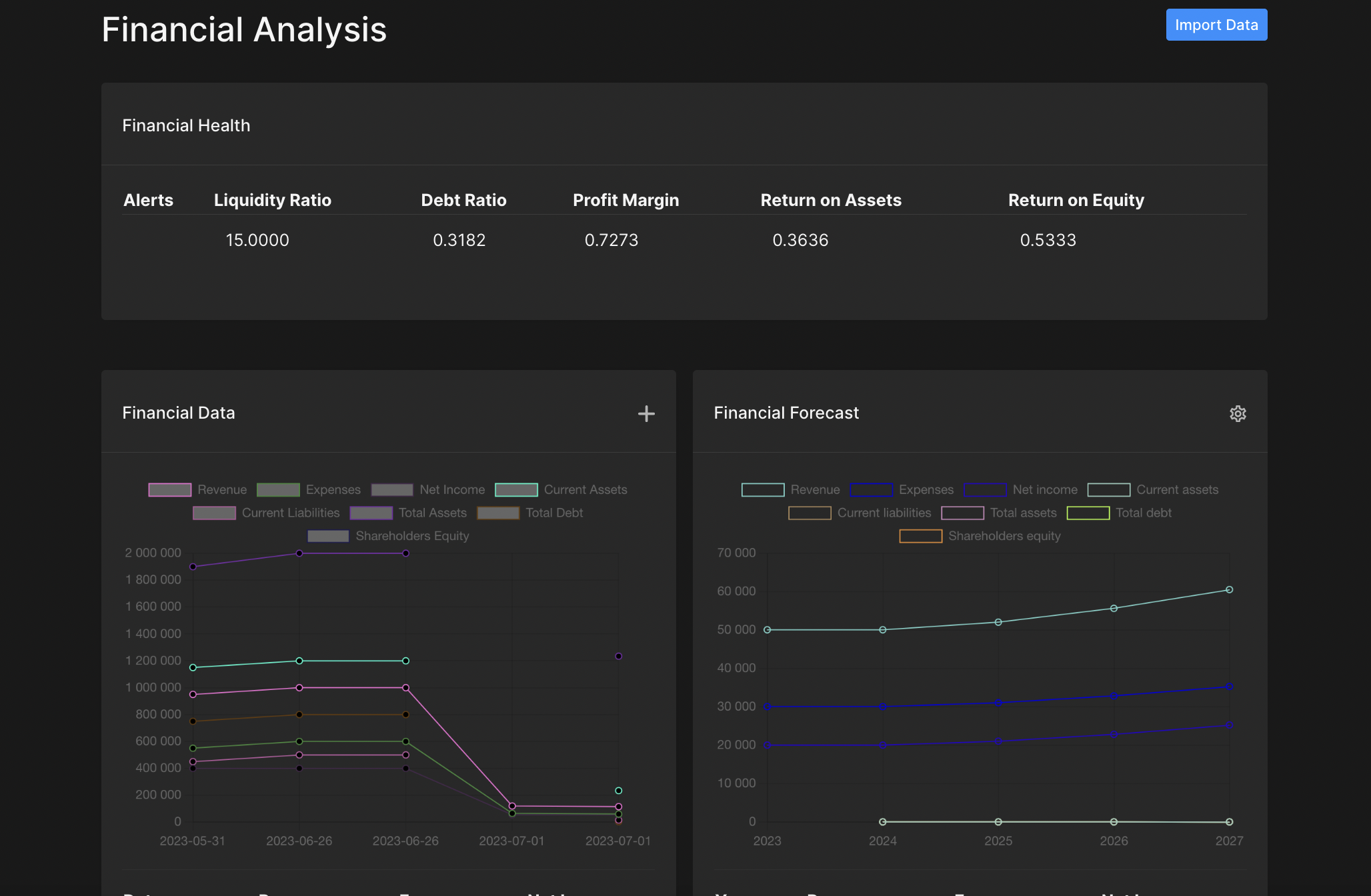
Our platform provides you with the tools to make informed, data-driven decisions for your business. With customizable financial forecasting, real-time data aggregation, financial health monitoring, and advanced analytics, you can gain valuable insights into a company's financial performance.
Targeted at investors, financial managers, and accountants, our platform helps you stay on top of your finances and make strategic decisions for growth.
Used by finance and investment teams in 4.5K enterprises.
How it works
Financial analysis and insights in three easy steps.
Generative Tools
More than 10 ai tools to perform costly and time consuming finance tasks.
| A | B | C | D | E | |
|---|---|---|---|---|---|
| 1 |
Transforming Complex Financial Data into Actionable Insights with AI
The world of finance is complex and constantly changing. Making sense of financial data can be a daunting task, even for seasoned professionals.
With FinanceGPT, financial data becomes a story worth telling. Our platform uses advanced AI/ML technology to analyze, interpret, and visualize financial data. We turn complex data into easy-to-understand charts and narratives, providing you with actionable insights and forecasts.
Quantitative intelligence behind FinanceGPT
FinanceGPT combines financial analysis, modelling and forecasting with governed quantitative computation. LargeQuant provides the underlying infrastructure for numerical models, simulation, verification and evidence-backed decision support.
LargeQuant is a Quantitative Intelligence Operating System for building, running, benchmarking and governing quantitative models across finance, risk, treasury, science and engineering. Its Verify and Forecast capabilities support reproducible results without treating language generation as the source of numerical authority.
The quantitative intelligence stack
Numerical computation, forecasts and scenarios.
Recompute claims and evaluate model performance.
Model lineage, validation and controlled execution.
Gartner names Large Quantitative Models a top strategic technology trend for 2027
Gartner lists Large Quantitative Models (LQMs) first among its Top 10 Strategic Technology Trends for 2027, within the nontextual AI frontier. Its research highlights the use of specialised quantitative models for forecasting, simulation and enterprise decision-making.
Gartner describes LQMs as modular hybrid neural architectures that combine quantitative datasets with mathematical, statistical and numerical methods and domain knowledge. Its recommended adoption steps include hybrid AI architectures, high-value modelling use cases, data validation and ModelOps governance.
In March 2026, Gartner also published dedicated LQM research addressing complex financial and scientific workloads. FinanceGPT participated in Gartner case-based LQM research in 2026, sharing technical architecture and implementation briefings.
Gartner 2027 outlook
Large Quantitative Models appear first in the list of ten strategic technology trends for 2027.
By 2030, Gartner forecasts that LQMs will replace LLMs in 25% of strategic forecasting and operational modelling tasks across major enterprise functions.
A Gartner forecast, not a measured current adoption rate or a performance claim for FinanceGPT.
Funding and Partnership Ecosystem
FinanceGPT Labs (formerly IPOXCap AI) is supported by and has a strong finance, tech and data science ecosystem.






FinanceGPT's financial analysis software and AI financial tools suite and agents accelerate financial data analytics, investment portfolio optimization, financial workflow automation and adoption of generative AI for finance. FinanceGPT Labs has been working on and deploying Large Quantitative Models (LQMs) as a distinct category, particularly within the generative Al space for quantitative finance, built as a hybrid with Hot Desk Imputation, KNN Imputation, VAEGAN and GPT/FinBert since August 2022. A whitepaper that introduced and created the Large Quantitative Models category of generative AI authored by Phiwa Nkambule was publicly released on 9 December 2023.
Ready to get started?
Create an account in seconds.